
BLUE POINT
The BLUEPOINT project tackles marine plastic waste by establishing a replicable Blue Circular Economy model in the Atlantic region. It aims to create a multi-stakeholder ecosystem of innovation and entrepreneurship, focusing on developing marketable solutions for glocalization, recovery, and processing of marine plastic. The goal is to reduce environmental impact and accelerate over 25 venturing initiatives to create new, sustainable businesses.
Giving New Life to Wind Turbine Blades Through Innovation and Sustainability
The EU-funded EoLO-HUBs project is developing innovative solutions to efficiently dismantle, recycle, and reuse end-of-life wind turbine blades. The research focuses on improving low-carbon thermal and chemical recycling technologies to recover high-quality materials, like reinforced fibres, for reuse in construction and automotive industries, promoting a circular economy. The project also includes a Knowledge Hub to share best practices and connect experts in sustainable blade management.
First EU4Dual Partner Labs Internship Exchange

As part of the EU4Dual alliance, ESTIA welcomed Margarita, a student from Savonia University of Applied Sciences, for the alliance’s first research internship exchange. Hosted by ESTIA’s Research Department, Margarita contributed to the development and deployment of a device designed for optimizing water irrigation systems, combining technical innovation with sustainability-focused research. The experience marked a significant milestone for cross-border student mobility and international research cooperation.
Questioning our learning process through engineering integrating a sustainability approach

This initiative designs educational content according to a defined set of specifications, with the aim of improving the learning process for both students and teachers. In this context, we integrate environmental and social considerations from the very beginning of the instructional design process. The objective is to create a coherent set of teachings delivered through various formats, fostering a new generation of engineers focused on the green economy and sustainable innovation.
Empowering Students Through Collaborative Innovation and Real-World Problem Solving
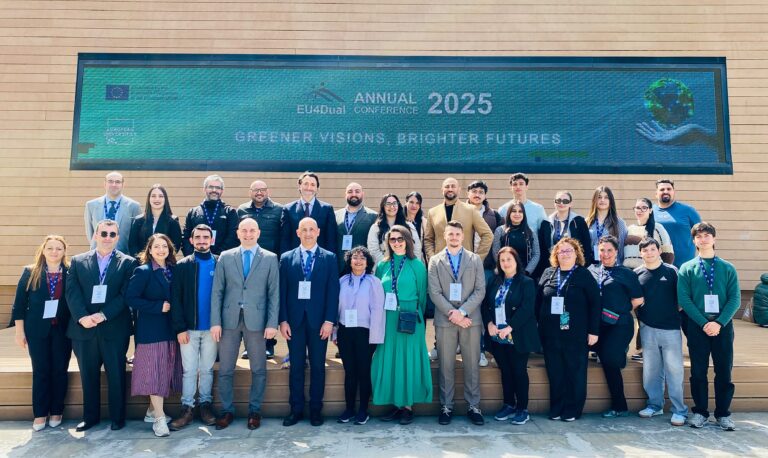
As part of the EU4DUAL 2025 Annual Conference, 11 MCAST students participated in a dynamic 24-hour innovation challenge. They collaborated with peers from nine universities to solve real-world sustainability issues. This intense, hands-on experience fostered creativity, teamwork, and practical problem-solving under pressure. Participants praised the challenge as a highlight, deepening their understanding of sustainable business practices and preparing them for future global challenges.
EU4Dual Sustainability Report

The European University Alliance EU4DUAL has published its first sustainability report. This 44-page report, based on the European Standards for Sustainability Reporting (ESRS), covers the year 2023 and provides an overview of EU4DUAL’s sustainability performance. It includes data from nine partner universities and input from stakeholders like students, staff, and industry partners. The report addresses topics such as the value chain, emissions data, and the alliance’s sustainability strategy.
Giving new life to wind turbine blades through innovation and sustainability
Wind energy is key to a cleaner future, but what happens when wind turbine blades reach the end of their life? The EoLO-HUBs project, funded by the European Union, is developing innovative solutions to dismantle, recycle, and reuse these massive structures in an efficient and sustainable way.
Building Micro-Grid Demonstrator at ESTIA
ESTIA has developed a Smart Building demonstrator at the ESTIA Berri campus featuring 314 photovoltaic panels covering 608m² with 127 kWc production capacity. Launched in 2023, this micro-grid aims to reduce the campus’s energy bill and carbon footprint while serving as an open platform for research in renewable energy integration. The building showcases ESTIA’s EnerGEA technological platform and fosters collaboration with laboratories and industry partners in electrical engineering and renewable energy.
Empowering students through collaborative Innovation and real-world problem solving
MCAST students took part in a 24-hour innovation challenge. They worked with students from nine universities to solve real sustainability problems. This hands-on experience encouraged creativity, teamwork and problem-solving under pressure. MCAST participants said the challenge was the best part of the event, with several teams winning awards. The project helped them understand sustainable business practices and prepared them for future global challenges.
Research speed networking goes EU4Dual

The second Research Speed Networking event at FH JOANNEUM helped researchers from different fields meet and share ideas. The event showcased research opportunities within the EU4DUAL project, with presentations by Johanna Muckenhuber and Nina Besirevic. People took part in three-minute discussion rounds, making new contacts and developing joint ideas. Organised by the Research Organisation and Services Department, the event aimed to encourage collaboration across departments, with plans to continue in spring 2024.