
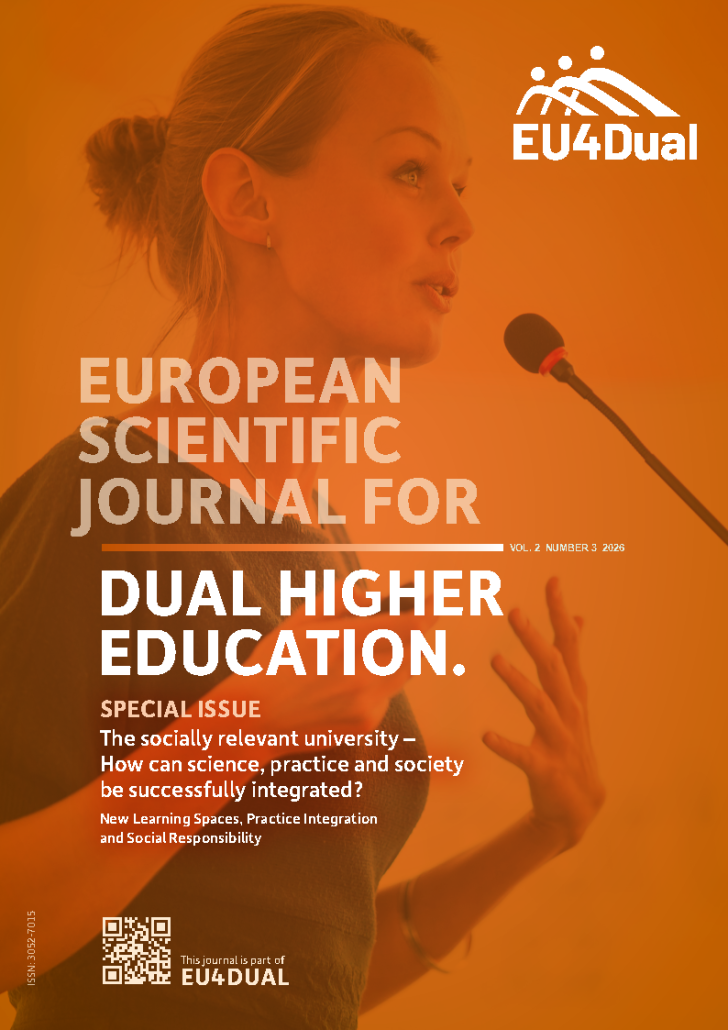
The European Scientific Journal for Dual Higher Education (ESJ DHE) has published two companion issues, Vol. 2 No. 2 and Vol. 2 No. 3 (2026), bringing together selected contributions from the 2025 Annual Conference of the German Society for Higher Education Research (Gesellschaft für Hochschulforschung – GfHf) in Heilbronn.
Under the overarching theme of “The socially relevant university – How can science, practice and society be successfully integrated?”, the two issues explore how universities can respond to changing societal expectations, technological transformation, new competence requirements, and the growing need to connect academic learning, professional practice, and society.
Vol. 2 No. 2 – “Societal Relevance, Future Competences and Institutional Transformation” focuses on the purposes and capabilities higher education needs in times of change. Its contributions examine the societal relevance of higher education, digital and future skills, the further development of cooperative higher education, artificial intelligence (AI) literacy and the institutional implications of AI, as well as new approaches to competence development and curriculum design.
Vol. 2 No. 3 – “New Learning Spaces, Practice Integration and Social Responsibility” shifts the focus towards the environments, relationships, and organisational arrangements through which transformation becomes tangible. The issue addresses digital and agile learning environments, collaboration between academia and industry, practice-integrated learning, professional development, transfer-oriented research, and educational inequality, highlighting the diverse ways in which higher education can strengthen connections between academic learning, professional practice, and society.
Together, the two companion issues provide a broad perspective on the transformation of higher education – moving from questions of societal purpose and future competences to learning spaces, practice integration, transfer, and participation.
For EU4DUAL, this publication is particularly relevant. The contributions address many of the questions at the heart of Dual Higher Education: how academic and professional learning can be meaningfully connected, how universities and the world of work can collaborate, and how higher education can prepare learners and institutions to respond responsibly to technological and societal change.
These publications further strengthen ESJ DHE as a European academic platform for research, reflection, and exchange on Dual Higher Education and related developments in higher education.
Vol. 2 No. 2 and No. 3 are now available online click here
Researchers, practitioners, higher education institutions, companies, policymakers, and students from Europe and beyond are warmly invited to contribute to future issues of ESJ DHE. For the current Call for Papers please click here.