
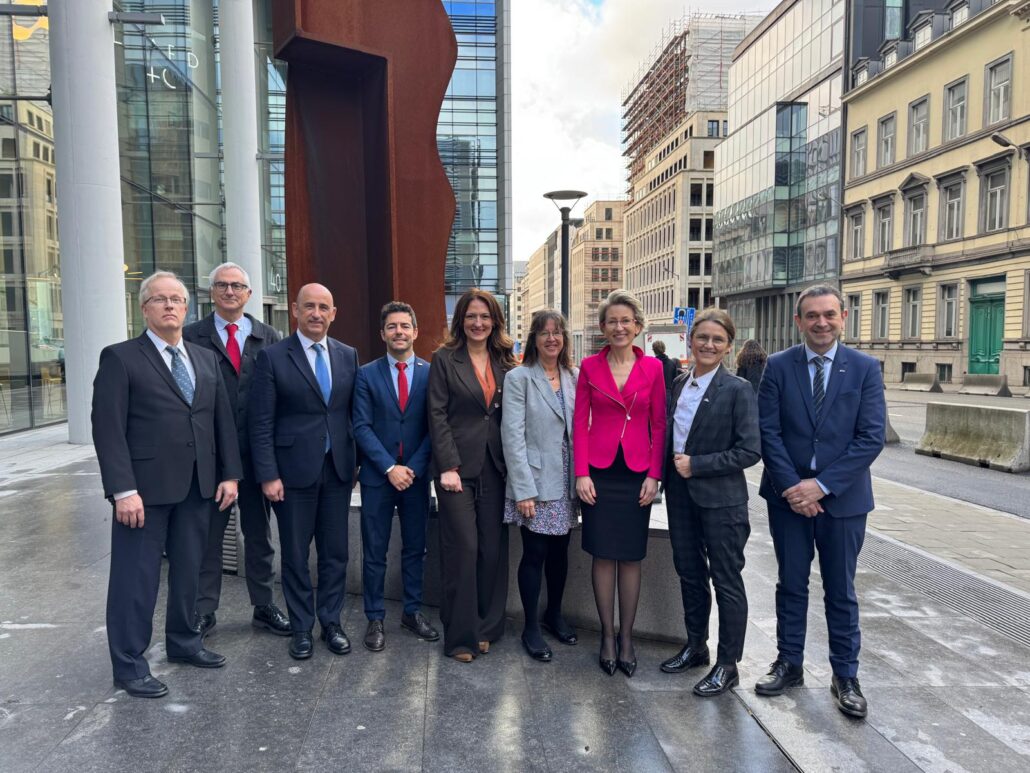
Brussels, 16–17 February 2026
The Rectors’ Council of the EU4DUAL European University Alliance met in Brussels to review progress and shape the next phase of the Alliance’s development.
Hosted by EURASHE, the meeting brought together the leadership of the nine partner universities at a decisive moment for EU4DUAL’s long-term consolidation and integration.
Strengthening Governance and Sustainability
A central milestone was the operationalisation of the Alliance’s legal entity (AISBL). The Council approved the accession of Koszalin University of Technology (KUT) and Duale Hochschule Baden-Württemberg (DHBW), reinforcing EU4DUAL’s governance framework and enabling structured joint services and coordinated implementation.
The extension period application and its associated budget were also approved, ensuring continuity between project phases and supporting the transition toward a sustainable operational model under the AISBL structure.
Endorsing the 10-Year Strategy
The Rectors formally endorsed the EU4DUAL 10-Year Strategy (2026–2036), setting a clear long-term direction for the Alliance.
Structured around consolidation, systemic integration and global positioning, the strategy aligns with the Joint Long-Term Mission and provides a roadmap for the coming decade.
Advancing Academic Development
Progress in academic implementation continues:
- Joint Master programmes are advancing toward accreditation and delivery.
- The Joint Industrial PhD strengthens the Alliance’s applied research ecosystem and cross-border industry collaboration.
- Work on the Centre of Excellence and the Dual Studies Quality Label progresses toward establishing a recognised European framework for Dual Higher Education.
Industry success stories highlighted the tangible impact of EU4DUAL’s university–industry model.
Mobility and Internationalisation
Student and staff mobility pathways continue to expand in line with strategic objectives, reinforcing the Alliance’s contribution to European skills development.
Next Steps
The Council identified immediate priorities:
- Operationalising the AISBL structure and service framework
- Finalising and submitting the approved extension application
- Strengthening recruitment and implementation of joint programmes
The meeting concluded with appreciation to EURASHE for hosting, to the Representation of the State of Baden-Württemberg to the European Union for the reception, and to Eurochambres for their participation.
EU4DUAL continues to consolidate its position as a coordinated, governance-driven and forward-looking European University Alliance.