
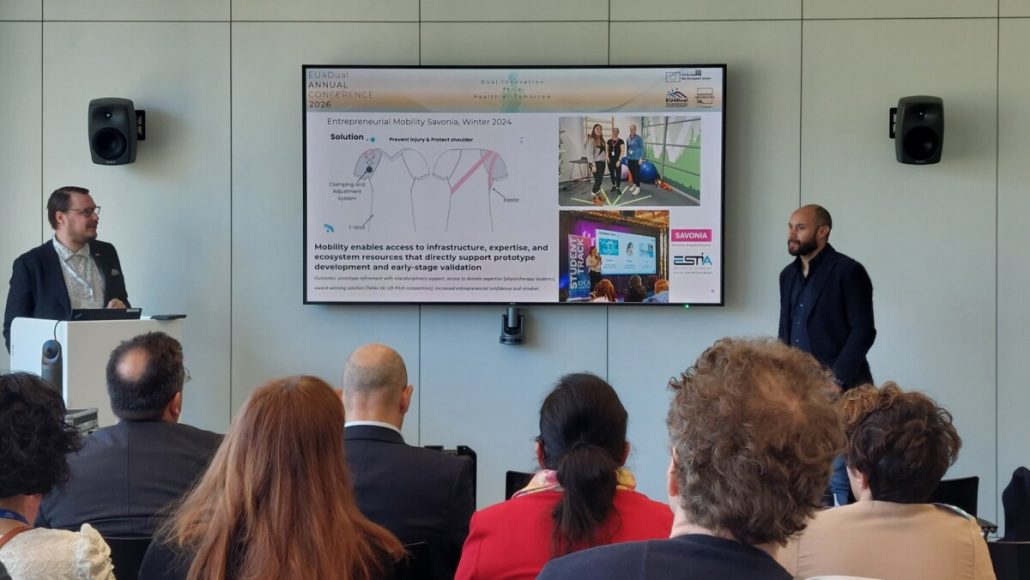
Entrepreneurial mobility is becoming an increasingly relevant pathway for students who want to move beyond classroom-based entrepreneurship and develop real ideas in real innovation ecosystems.
Within EU4Dual, this approach reflects one of the Alliance’s core ambitions: connecting education, work-based learning, research, innovation and regional ecosystems across Europe. Instead of treating mobility only as a study-abroad experience, entrepreneurial mobility creates opportunities for students to access mentors, laboratories, incubators, business coaches, startup hubs and sector-specific expertise across different partner institutions.
A recent Savonia article explores how practice-based entrepreneurial mobility can support students in developing entrepreneurial skills, testing ideas, refining prototypes and connecting with European innovation environments. The article is based on EU4Dual mobility experiences and highlights how students can benefit from structured support while maintaining ownership of their entrepreneurial projects.
This model is especially relevant for the future of work. Students and early-stage entrepreneurs need more than theoretical knowledge: they need environments where they can validate assumptions, meet potential users, receive feedback, build prototypes and understand how their ideas may create value in different European contexts.
For EU4Dual, entrepreneurial mobility also contributes to a broader objective: building a European-native environment for commercialization. By connecting complementary strengths across the Alliance, students can begin to see Europe not as a later expansion market, but as a natural starting point for developing ideas, services and ventures.
The experience also points to an important institutional lesson. If universities want to strengthen innovation and entrepreneurship, they need to create visible pathways, reliable hosting structures, access to practical resources, mentoring and recognition mechanisms. Entrepreneurial learning becomes more powerful when it is embedded in real ecosystems and connected to concrete development work.
Through this work, EU4Dual continues to explore how dual higher education can support not only employability, but also innovation capacity, entrepreneurial agency and stronger cooperation between universities, companies and regions.
Read the full article by Savonia University of Applied Sciences: https://www.savonia.fi/en/articles-pro/entrepreneurial-mobility-as-a-pathway-toward-a-european-native-environment-for-commercialization/