
Overview
The Programme
Industry & Admission
Careers & Research

Study across leading European partner universities, specialise in one of four advanced manufacturing tracks, and gain practical experience through EU4Dual’s work-based learning model.
The European Joint Master in Digital and Sustainable Manufacturing Engineering is designed to prepare engineers for the future of sustainable, digital and human-centred industry.
Next intake: September 2026
Applications close: July 2026
Free to apply · 100 places across 4 tracks · Guidance for mobility and pre-arrival procedures
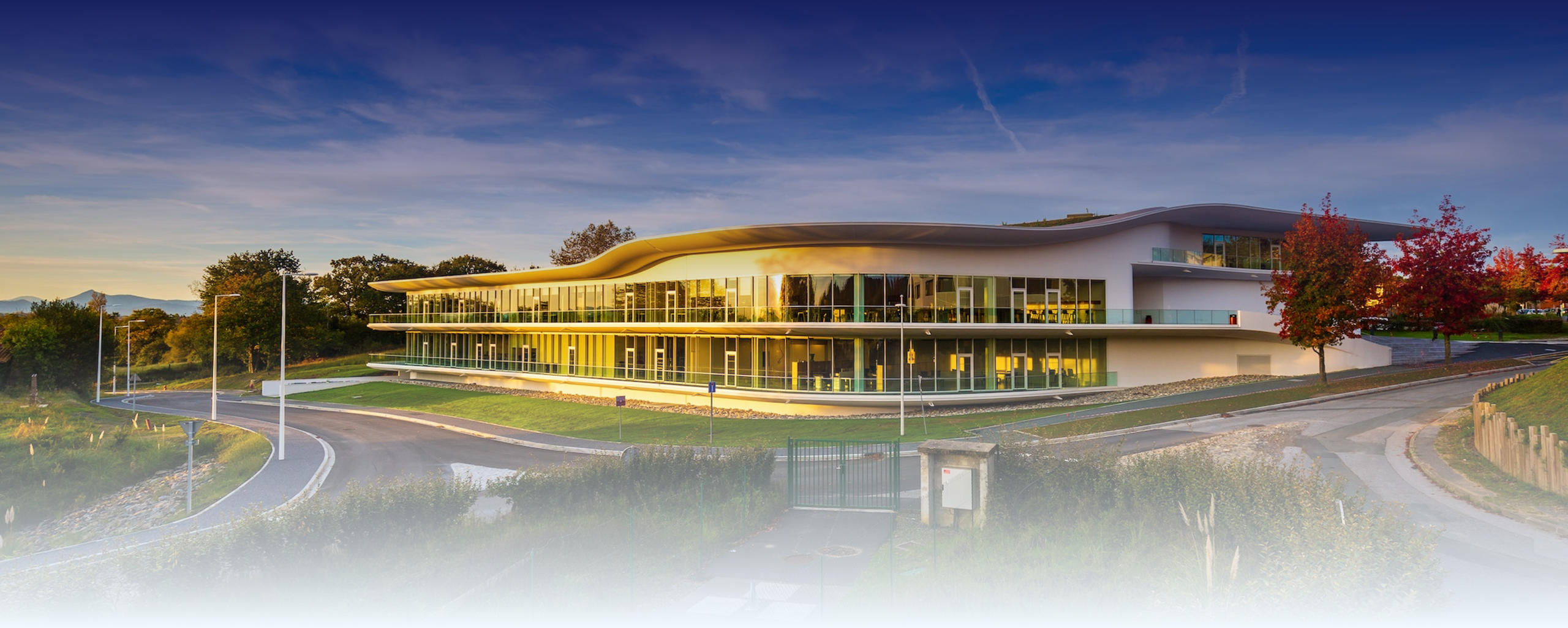
The programme is developed by EU4Dual partner universities and connects students with academic, industrial and regional ecosystems across Europe.


DHBW ⋅ MCAST ⋅ John von Neumann University ⋅ PAR University College ⋅ Savonia University of Applied Sciences
Manufacturing is changing fast. Digitalisation, sustainability, circularity and human-centred technologies are reshaping how products are designed, produced and delivered.
The European Joint Master in Digital and Sustainable Manufacturing Engineering prepares students to become engineers capable of responding to this transformation.
Through academic learning, international mobility, applied projects and work-based learning, students develop the technical, digital and transversal skills needed in modern industrial environments.
This Master’s prepares students to address the green and digital transformation of manufacturing from an engineering perspective.
Students will develop the ability to connect advanced engineering knowledge with sustainability, digitalisation, applied innovation and real industrial challenges.

The programme focuses on digitalisation, sustainability, circularity and human-centred manufacturing — key priorities for Europe’s industrial transformation.

Choose between Simulation-driven Innovation in Manufacturing, Smart Production Engineering, Additive Manufacturing Technologies or Robotics for Manufacturing.

The curriculum is aligned with advanced manufacturing, sustainable industry and digital production needs.

Students combine academic learning with practical, work-based learning experiences connected to industry and applied research.

The programme is developed by EU4Dual partner universities and connects students with different academic, industrial and regional ecosystems.

Students benefit from an alliance working on joint education, research, mobility, micro-credentials and industry collaboration.
From your application to graduation – here’s what your full experience looks like, stage by stage, across the EU4Dual Alliance.
Pre-arrival support
A guided start, before you set foot on campus
From the moment you apply, the alliance supports you through every administrative step, so arriving in a new country feels like joining a community, not navigating paperwork alone.
Apply online
Enrol
Student agreement
Visa & mobility support
From € 450 / month
Erasmus+ mobility grants support every mobility leg of your journey
First Semester
Transversal foundations
October – February

Landing week
Bilbao, Spain
Meet your cohort and alliance in person
+
Online phase
8 weeks · All cohorts
Shared transversal foundations, studied together online.
+


Mobility weeks
Graz · Digital transition
Kuopio · Green transition
Second Semester
Specialisation
February – July
150 hours of work experience
First work-based learning experience embedded in the semester.
Choose one of four specialisations:
Mondragon University
Simulation-driven Innovation in Manufacturing
OR
FH Joanneum
Smart Production Engineering
OR

Koszalin UT
Additive Manufacturing Technologies
OR

ESTIA
Robotics for Manufacturing
Third Semester
Master thesis in industry
September – March
6 months of work experience
Thesis embedded in a European company
+
Mobility Week
Research & Innovation
Bilbao, Spain
After graduation
Opportunities for an EU4Dual engineer
You leave with a single joint European Master's degree and a network across four countries, opening pathways into industry, research and continued learning.
Industry occupations
CTO, Manufacturing engineer, Simulation engineer, Robotics lead...
Research & PhD
Direct pathway to doctoral programmes across EU4Dual partners
Lifelong learning
Access to micro-credentials and executive modules after graduation
In the second semester, students choose one advanced manufacturing specialisation hosted by one of the programme’s academic partners.
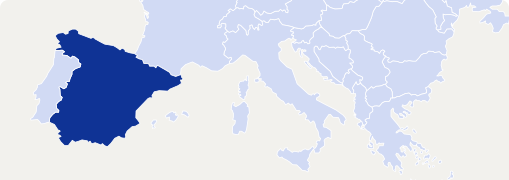
This track focuses on the use of simulation, modelling, data analysis and advanced manufacturing processes to support innovation in smart and sustainable manufacturing.
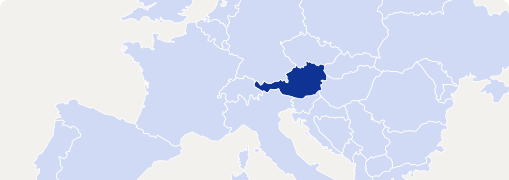
This track prepares students to work with smart production systems, digital production environments and the integration of data-driven technologies into industrial processes.
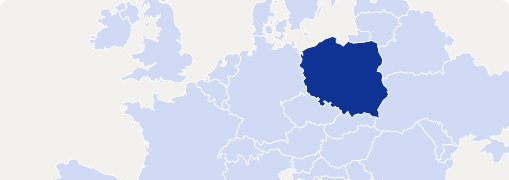
This track focuses on additive manufacturing technologies, materials, design approaches and process modelling for advanced industrial applications.
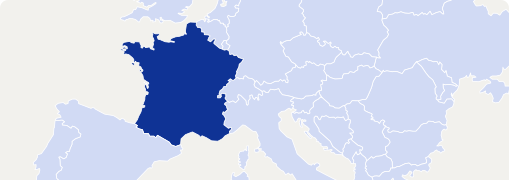
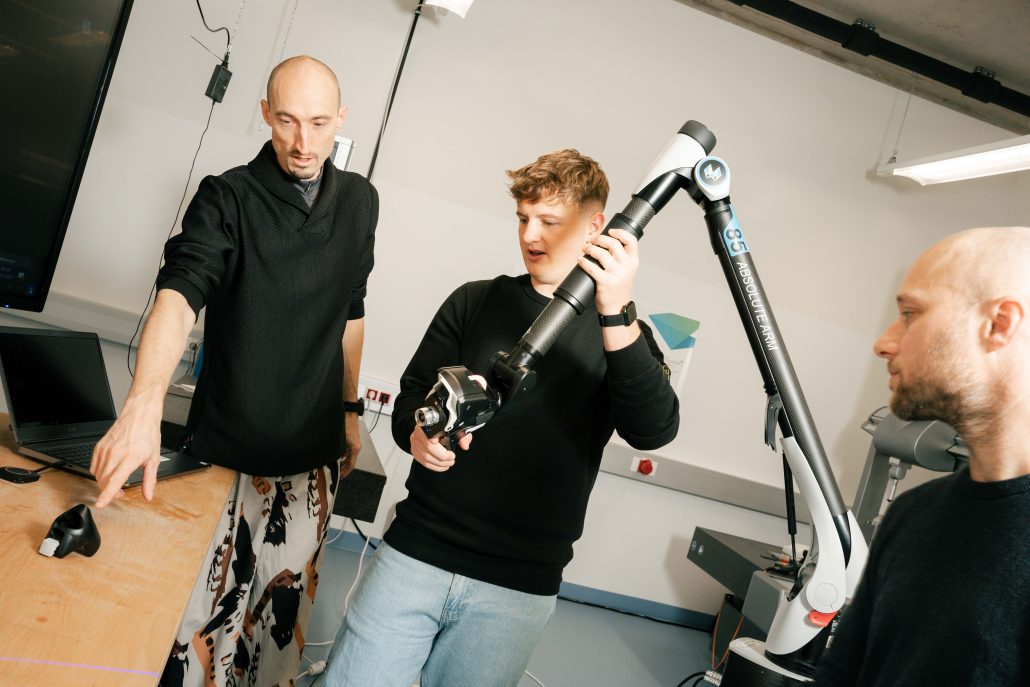
This track focuses on robotics and robotised processes for manufacturing environments, including industrial cells and advanced applications.
EU4Dual’s dual model connects academic learning with practical experience in real professional environments.
Students are expected to apply technical knowledge to industrial and organisational challenges, working across borders, disciplines and learning contexts.
Work-based learning conditions, including possible remuneration, depend on the host organisation, country, placement format and applicable regulations.
The programme connects students with several EU4Dual partner ecosystems across Europe.
Mobility is designed to support international learning, academic collaboration and exposure to different industrial regions.



Additional EU4Dual mobility opportunities may involve other alliance partners, depending on the programme structure and academic planning.
Mobility arrangements, available destinations and grant eligibility may depend on academic pathway, institutional agreements and Erasmus+ rules.
The Master’s has been designed with strong attention to industry relevance.
EU4Dual partner universities work closely with regional and international industrial ecosystems, supporting work-based learning, applied projects, research collaboration and innovation.
Students may have opportunities to engage with companies, research centres or applied innovation environments through projects, work-based learning and thesis activities.
The programme aims to prepare graduates who can contribute to the transformation of manufacturing through digital technologies, sustainability-oriented thinking and advanced engineering skills.
The European Joint Master in Digital and Sustainable Manufacturing Engineering is developed within the EU4Dual Alliance.
ESTIA School of Engineering, France, participates as a core academic partner and hosts the Robotics for Manufacturing specialisation.
The programme is also connected to the wider EU4Dual network through mobility, academic collaboration and alliance activities.
Applicants are expected to hold a Bachelor’s degree or equivalent qualification in engineering or a closely related field.
Specific eligibility requirements may depend on the academic background of the applicant and the regulations of the degree-awarding institutions.
For access to doctoral studies, students may need to reach 300 ECTS depending on their previous studies and national regulations. Applicants should check the specific requirements in the country where they intend to pursue doctoral studies.
Additional documentation may be requested during the admission process.
Tuition fees, mobility funding and possible work-based learning conditions will be communicated clearly before enrolment.


All participation costs are payable directly to the Coordinating Institution, Mondragon University.
Students may be eligible for Erasmus+ mobility support depending on the mobility period, destination, institutional rules and individual eligibility.
Company-based learning opportunities may be remunerated depending on the host company, country, placement format and applicable regulations.
Remuneration cannot be guaranteed unless explicitly confirmed in the placement agreement.
This may include information on:
This may include information on:
Specific requirements depend on nationality, country of study and local regulations. Non-EU students are strongly encouraged to check visa and residence requirements as early as possible.
The programme prepares students for technical, international and applied roles related to the future of manufacturing.
The programme also provides a foundation for further academic development, including doctoral studies, subject to national and institutional requirements.
Students engage with technical and industrial challenges linked to digital and sustainable manufacturing, supporting the development of solutions for modern production environments.
Through the Master’s thesis and applied learning activities, students are encouraged to work on challenges related to sustainability, digital transformation, industrial innovation and advanced manufacturing technologies
Yes. The programme is a European Joint Master.
The joint degree is awarded by Mondragon Unibertsitatea, FH JOANNEUM and Koszalin University of Technology.
ESTIA School of Engineering participates as a core academic partner and hosts the Robotics for Manufacturing specialisation, but does not award the joint degree.
The programme has 90 ECTS and is designed as an EQF Level 7 Master in Engineering.
The programme is taught in English.
The programme offers 100 places, with a maximum of 25 students per specialisation track.
Students can choose between:
Yes. The programme follows a dual learning approach, connecting academic learning with practical work-based learning experiences.
The specific format, host organisation and conditions may vary depending on the track, country and placement availability.
Some work-based learning opportunities may be remunerated, depending on the host company, country, placement format and applicable regulations.
Remuneration should only be considered confirmed when it is included in the official placement agreement.
The programme follows the European Approach for Quality Assurance of Joint Programmes and provides official documentation to support recognition processes.
Recognition may depend on national regulations and the intended use of the degree.
Graduates may be eligible for doctoral studies depending on national regulations and their previous academic background.
In some countries, access to PhD programmes may require a total of 300 ECTS, so students with a 180 ECTS Bachelor’s degree may need additional credits depending on the country and institution.
Students receive guidance and general information on pre-arrival procedures, including visa-related processes and accommodation options where applicable.
Specific requirements depend on nationality, country of study and local regulations.
Yes. The programme is open to international applicants who meet the academic and language requirements.
Non-EU students should check visa, residence and documentation requirements as early as possible.
The programme includes international and blended learning components.
Specific mobility requirements depend on the programme structure, specialisation track and institutional arrangements.
Students may be eligible for Erasmus+ mobility support depending on the mobility period, destination, institutional rules and individual eligibility.
Funding conditions will be communicated clearly before enrolment.
Join a European Joint Master designed for the green and digital transformation of industry.
Study in English, specialise in one of four advanced manufacturing tracks, and connect your academic learning with real industrial and applied challenges across the EU4Dual ecosystem.
Next intake: September 2026
Applications close: July 2026


Este proyecto ha sido financiado con el apoyo de la Comisión Europea. Este sitio web refleja únicamente las opiniones de los autores, y la Comisión no se hace responsable del uso que pueda hacerse de la información que contiene.